Physiotherapy clinics have a phone problem that dentists and GP surgeries mostly don’t. In a lot of small clinics there isn’t a full-time receptionist. The person who answers the phone is the physio, between patients, with five minutes to write up notes and wash their hands. Calls that land mid-session go to voicemail, and new patients rarely leave one.
An AI receptionist can take a lot of that pressure off. It can also cause problems if nobody has thought about where its job stops. So this post covers both: what it does well in a physio or private clinic, and the hard line it shouldn’t cross.
Why physio clinics miss more calls than most
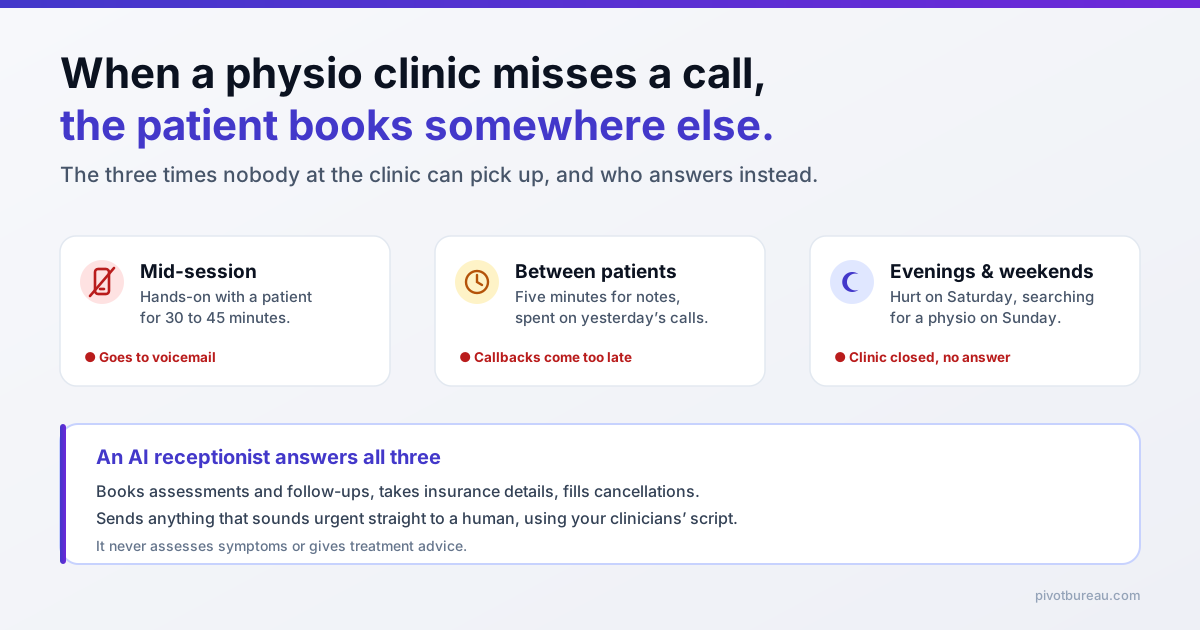
If you look at when calls go unanswered in a small clinic, it’s the same three windows every week.
- Mid-session. You’re hands-on with a patient for 30 to 45 minutes. Answering the phone isn’t an option, and you wouldn’t want it to be.
- Between patients. The five-minute gap is meant for notes. Instead it goes on returning yesterday’s voicemails, so notes slip to the evening.
- Evenings and weekends. Injuries don’t keep office hours. Saturday football, a weekend run, a Sunday in the garden. People search on a Sunday night and want something booked before Monday.
The person ringing is usually in pain and has picked you off a list of results. If you don’t answer, the next clinic on that list probably will. That’s the real cost of a missed call here. It isn’t just one appointment, it’s a whole course of treatment that goes to someone else.
The calls a physio clinic actually gets
Most clinic calls fall into a small number of types, and each one needs different handling. Writing them down is the first real step of any build.
Two details matter more than they look. First, new patients need an initial assessment, which is usually a longer slot than a follow-up. An agent that books a new back-pain patient into a 30-minute follow-up has just created a problem for Monday morning. Second, existing patients usually want the same physio. A good agent offers that person’s slots first and only offers others if the patient is happy to switch.
Red flags: the line it must never cross
Every physio knows that some calls that sound like “I’ve hurt my back” are something more serious. Spotting them is a clinical skill and it stays with registered clinicians. The HCPC standards of conduct are built around professionals working within their scope and managing risk to service users. A piece of software has no scope to work within.
So the agent doesn’t triage. It does something simpler and more reliable:
- Your clinicians write the stop list. A short set of phrases that mean “this needs a human now”. The NHS back pain page is a good example of the public wording, with its list of times to call 999 or go to A&E. Your team decides what goes on your list, not me and not the software.
- If a caller says something on that list, the agent stops. No more booking questions and no reassurance. It reads out the safety message your clinicians approved, word for word.
- A human gets alerted straight away by text, call or both, with what the caller said in their own words.
Done this way, the agent is more consistent than a stressed person on a busy Saturday. It says the right thing in exactly the same words every time, and it never talks itself into “it’s probably fine”.
Insurance callers
Plenty of private physio is paid for through health insurance, and those calls take longer than they should. Most insurers want an authorisation number before treatment starts, and the rules vary by policy.
The agent can collect what your team needs to check the claim:
- The insurer’s name
- The membership or policy number
- Any authorisation or pre-authorisation code the patient already has
- Whether a GP or the insurer has referred them, if your clinic needs to know
What it must never do is tell someone they’re covered. Only the insurer can confirm that. The agent says your team will check the details before the first appointment, which is exactly what a good receptionist would say.
Cancellations and the waiting list
This is the quiet win. When a patient cancels at short notice, that slot usually stays empty, because nobody has time to work through a list of names. An agent can do it while you’re treating. When a slot opens, it messages the people who asked for an earlier appointment, by WhatsApp or text, and books the first person who says yes.
Most clinics have more people wanting an earlier slot than they realise. They just never get round to ringing them. I’ve written more about how this works across different businesses in AI appointment setters for small business.
Booking straight into your diary
Whether the agent can book directly depends on your practice management system, not on the AI. Some systems, such as Cliniko, have a public API that an agent can book against. Others don’t offer one, and then the agent captures the booking for your team to confirm. Both work. The second is a bit slower for the patient, but much faster than voicemail.
| Books directly | Captures for your team | Voicemail | |
|---|---|---|---|
| Needs | A diary system with an API | Any diary system | Nothing |
| Patient hears | “You’re booked for Tuesday at 10” | “We’ll confirm by text this morning” | A beep |
| Your team does | Nothing, unless flagged | A quick confirm between patients | Rings back, often too late |
| Risk to watch | Wrong slot length | Slow confirmation | Patient books elsewhere |
Phone or chat? For a physio clinic I’d usually start with voice, because someone in pain picks up the phone. Website chat earns its place too, though, especially for “how much is an assessment?” questions late at night. Voice costs more to run, because every minute has a real metered cost. I broke that down in what an AI phone receptionist costs per minute.
Patient data is health data
This is where clinics need to be stricter than most businesses. A note that says “lower back pain, two weeks” is information about someone’s health, and UK GDPR treats that as special category data, with extra conditions on how you use it. That doesn’t rule out an AI receptionist, but it does mean you keep its job narrow.
- A written data processing agreement naming the provider as your processor. The ICO’s guidance on controllers and processors sets out what it has to cover.
- Data minimisation. The agent collects what it needs to book, and nothing more. The assessment is where the detail belongs.
- Know where the data lives. Which sub-processors, which country, and how long it’s kept. Ask plainly. If the answer is vague, that tells you something.
What it’s worth, honestly
The sum is simpler than most vendors make it. Pull two numbers from your phone system for one month: calls that went unanswered and calls that came in outside opening hours. That’s your leak. Then weigh it against what a new patient is worth across a typical course of treatment, not the price of one session.
You can run your own version with our free AI chatbot cost calculator, using your numbers rather than mine. Current plans are on the pricing page, and I’d rather you read them there than take a figure from a blog post that could go out of date.
One thing I won’t do is quote you a conversion rate from someone else’s clinic and call it yours. Every clinic’s mix of new patients, insurance work and follow-ups is different. The mechanics in this post are the ones I build with. Your numbers are worth measuring properly before and after, and I’d want to measure them with you rather than promise them.
You’re not replacing anyone on your team. You’re making sure the person who rings on Sunday night, in pain, gets booked in rather than sent to voicemail.
A sensible rollout order
- Measure the leak. One month of missed and out-of-hours calls. That number is your business case.
- Get your clinicians to write the stop list and safety message before anything else. This is the most important part of the build.
- Map your appointment types: initial assessment, follow-up, any specialist sessions, and how long each one runs.
- Get the data processing agreement in writing and confirm where data is stored.
- Decide booking depth. Direct into your diary if it has an API, or capture-and-confirm if it doesn’t.
- Read a month of transcripts. Real calls show you what to tighten. This is where a properly run agent keeps improving and a scripted bot doesn’t, which is the difference I explain in AI receptionist vs agentic AI.
If you want to map your own calls before talking to anyone, our free AI receptionist call-flow worksheet walks you through it. The dental version of this article covers a similar clinic setting, and if you’re weighing this against hiring, see AI receptionist vs human receptionist.