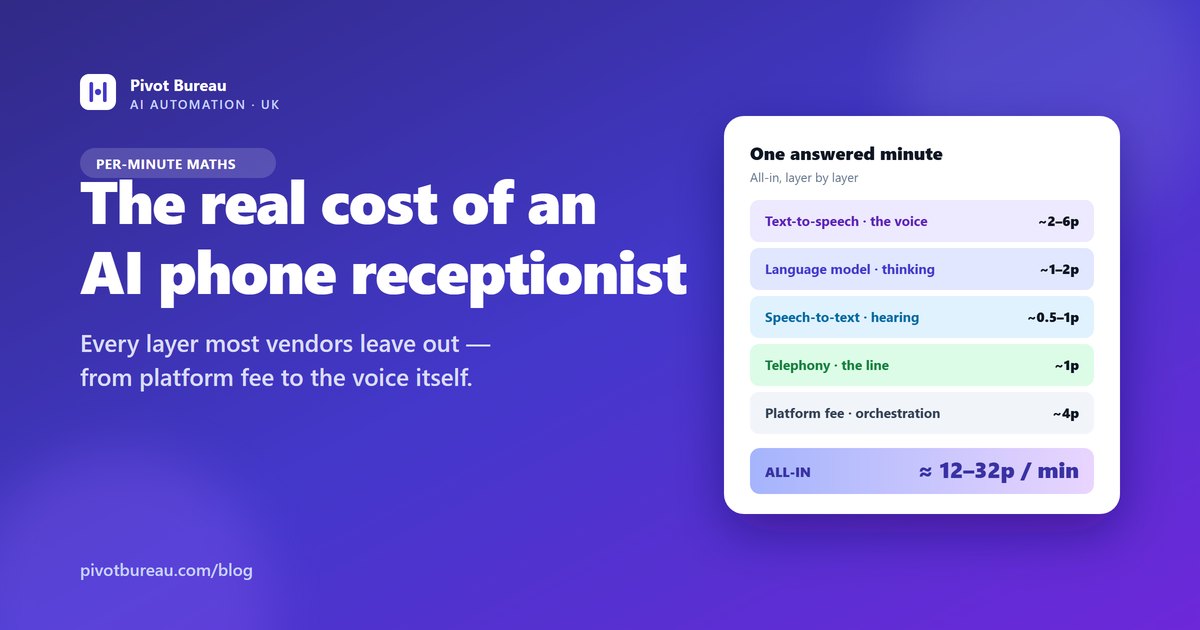
Search “AI phone receptionist cost” and you’ll see a tidy figure — often something like “from 4p a minute”. It’s not wrong, exactly. It’s just the bottom layer of a five-layer stack, quoted as if it were the whole thing. For a plain-English primer on the product itself, our guide to what an AI receptionist costs in the UK is the place to start; this article goes one level deeper, into the running cost of a voice agent specifically, because voice behaves completely differently from website chat.
Why voice is a different animal from chat
A website AI chat receptionist is close to free to run per conversation. Text in, text out, one language-model call — fractions of a penny. That’s why chat plans can sensibly be sold as a flat monthly fee with no per-message charge, which is exactly how our chatbot plans work.
Voice is not like that. Every second the agent is on a call, it’s paying for a live phone line, transcribing the caller in real time, thinking, and generating natural speech — continuously. Those are metered, variable costs. It means a voice agent has to be priced on usage, not just a flat fee, or someone ends up out of pocket. Understanding the difference between a scripted bot and a true acting agent helps here too; we cover that in AI receptionist vs agentic AI.
The five layers of a per-minute cost
Here is what actually gets billed while an AI voice agent is on a call. The figures below are representative UK-facing estimates based on published 2026 provider rates — treat them as a realistic shape, not a quote, because your exact numbers depend on the models and voice you pick.
Reading it from the bottom up:
- Platform (~4p/min). The orchestration layer that ties everything together in real time — for example Vapi, which we use. This is the number that gets quoted as “the price”. It isn’t.
- Telephony (~1p/min). Carrying the actual call. If you keep your existing number and forward it to the AI line, this is a metered leg on top.
- Speech-to-text (~0.5–1p/min). Transcribing the caller live, e.g. with Deepgram. Cheap and fast.
- Language model (~1–2p/min). Deciding what to say. A lightweight model like GPT-4o-mini keeps this low; a frontier model would multiply it.
- Text-to-speech (~2–6p/min). The natural voice. This is usually the single biggest layer, and a premium voice can cost several times a standard one.
Add them and a realistic all-in figure lands around 12–32p per answered minute. (Costs are billed by providers in US dollars; we’ve converted at roughly £1 = $1.27, so the pence figures move a little with the exchange rate.) Independent 2026 breakdowns of voice-AI stacks put the same all-in number in a similar band once every layer is counted — well above the platform fee alone.
Why “unlimited minutes” is usually a trap
Once you can see the stack, the marketing claims sort themselves out. If every minute costs real money, a genuinely unlimited voice plan can only work one of three ways: it’s priced high enough to survive your heaviest possible month (so light users overpay), it quietly throttles or drops quality when you get busy, or the provider is losing money and won’t be around long. None of those is what you want answering your phone.
The honest structure is the boring one: a monthly fee that includes a sensible bucket of minutes, then a clear per-minute rate beyond it, and a hard cap you control. That way a quiet month is cheap, a busy month is predictable, and nobody is pretending a metered cost is free.
This is exactly how we structured our own AI phone receptionist plans. And it’s worth saying plainly, because the blog strategy we hold ourselves to forbids inventing results: we haven’t yet run this at scale for a paying client, so this isn’t a case study with a headline ROI number. What it is is the honest cost model we built the product on — and you can hear the same voice agent answer in the browser on our AI receptionist page.
Putting real numbers to it
Here’s how the maths flows through to a price. We chose a pay-as-you-go shape: a small monthly fee that covers the number, the hosting and the first 60 minutes, then a flat rate for every minute after that. A quiet month costs you little; a busy month costs more, but only because the agent was busy answering calls you’d otherwise have missed.
| Answered minutes in a month | Monthly fee | Extra minutes at 25p | Bill for the month |
|---|---|---|---|
| 60 (a quiet month) | £29 | £0 | £29 |
| 200 | £29 | £35 | £64 |
| 500 | £29 | £110 | £139 |
The one number that has to hold is the per-minute rate: it must sit comfortably above your all-in cost per minute, or every extra minute loses money. That’s why we built our own stack — a lightweight language model and a budget voice — to run at the low end of the 12–32p range above, and priced extra minutes at 25p rather than advertising “unlimited”. If you want to sanity-check any provider’s plan, do one division yourself: what you’d pay in a busy month ÷ the minutes answered, and ask whether that number can plausibly cover five metered layers.
The costs that aren’t charged by the minute
Per-minute is the big variable, but a few fixed costs sit alongside it — worth knowing so nothing catches you out later:
- Setup (one-off). Building the call flow, training the agent on your services and prices, choosing and tuning the voice, and wiring it to your calendar. That’s real work, usually charged as a one-off fee rather than buried in the monthly.
- The phone number. A dedicated AI number rents for pennies a month. Keeping your existing number instead means a call-forwarding leg on your own line’s plan — small, but it’s yours, not the AI’s.
- Concurrency. How many calls the agent can answer at once. Most small businesses never need more than a line or two, but a clinic at 8am on Monday might — and extra simultaneous lines usually carry a small monthly cost.
None of these is large, but they belong in the picture: the per-minute rate is the running cost; these are the cost of having the thing at all.
A worked example (an illustration, not a client)
To make it concrete — and to be clear, this is a round-number illustration, not a real customer — picture a busy independent plumber. He misses six or seven calls a day: on a job, up in a loft, or after 5pm. Say the agent answers 200 calls in a month, and the average handled call runs about two and a half minutes. That’s roughly 500 answered minutes.
On our pay-as-you-go phone plan, that month costs £29 plus 440 extra minutes at 25p — £139 in total. If he sets a monthly cap, it can never go higher than the figure he chose. But for him the number that matters is a different one: if even two of those 200 answered calls turn into a boiler job he’d otherwise have missed, the month has paid for itself several times over. That is the whole calculation — answered minutes on one side, the value of a recovered job on the other.
What building our own taught us
Two things surprised us when we built and tuned Pivot Bureau’s own voice agent. First, how completely the voice dominates the bill: we’d assumed the language model would be the pricey layer, and it’s comfortably the cheapest of the AI components — the text-to-speech is the one to watch. Second, how much of the real cost is about handling silence and interruptions well. A call that sits in dead air, or an agent that talks over the caller, both waste metered minutes and sound worse. Tuning when the agent starts speaking, and ending calls that have gone quiet, does as much for the running cost as any model choice. Those are the unglamorous details that never appear on a pricing page but quietly decide whether the maths works.
So is it worth it? An honest test
Cost per minute only matters next to what a call is worth. For a business whose phone rings after hours, over lunch, or during jobs — trades, clinics, salons, lettings — a single missed enquiry that would have booked is worth far more than the few pence the AI minute costs to answer it. That’s the whole case, and it’s the same logic behind an AI appointment setter: capture the contact you’d otherwise lose.
But be honest with your own numbers. If your phone rarely rings outside opening hours and every caller already gets through, a voice agent is a solution looking for a problem — website chat or a broader look at AI for your small business may be the smarter first spend. Our free AI cost calculator lets you compare doing nothing against a tool using your own figures, and the free tools hub has a few more.
The cheapest AI voice minute in the world is worthless if it answers a call no one would have made. The most expensive one is a bargain if it books the job you’d otherwise have missed. Start from the value of the call, not the price of the minute.
A quick checklist before you buy any AI phone plan
- Ask what’s included in the “per-minute” price. If it’s only the platform fee, the real cost is 3–6× higher once voice and models are added.
- Do the division. A busy month’s bill ÷ minutes answered = effective £/min. Compare it to a realistic 12–32p all-in cost.
- Confirm there’s a hard spend cap — and that the agent takes a message once it’s reached, rather than running the meter.
- Check the voice. A premium voice sounds lovely and can double your cost. Make sure the plan’s minutes still add up with the voice you actually want.
- Ask about call-length and silence limits. A max call duration and a silence timeout stop dead-air calls quietly burning minutes.
- Start on the tier below where you think you are. Watch a month of real usage, then move up. Overage is cheaper than paying for minutes you never use.
How Pivot Bureau thinks about it
We build done-for-you AI assistants for UK small businesses — chat first, voice when the call volume justifies it. The principle behind the pricing is the one in this article: metered costs get metered plans, quiet months stay cheap, and a hard cap means the bill can never surprise you. If you’re weighing it up, see how the AI receptionist works, compare the phone plans, or read the wider picture in beyond the chatbot: agentic AI for small business growth.