
“AI for estate agents” has become a noisy category. Some of it is genuinely useful; a lot of it is a chatbot with a rosette. Below is an honest, practical run-through — grouped by the job you're actually trying to do, not by vendor.
What “AI tools for estate agents” actually means
For a UK branch or independent agency, practical AI in 2026 falls into six jobs. Most agents get the biggest return from the first two.
1. Instant lead response & qualification (start here)
This is the one that pays for everything else. A buyer who enquires on Rightmove or Zoopla at 9pm is, at that moment, also enquiring with three other agents. Research on online lead response has shown for years that the odds of engaging a lead fall sharply within the first few minutes — and after an hour they collapse. A negotiator can't sit on the portal inbox all evening. An AI assistant can.
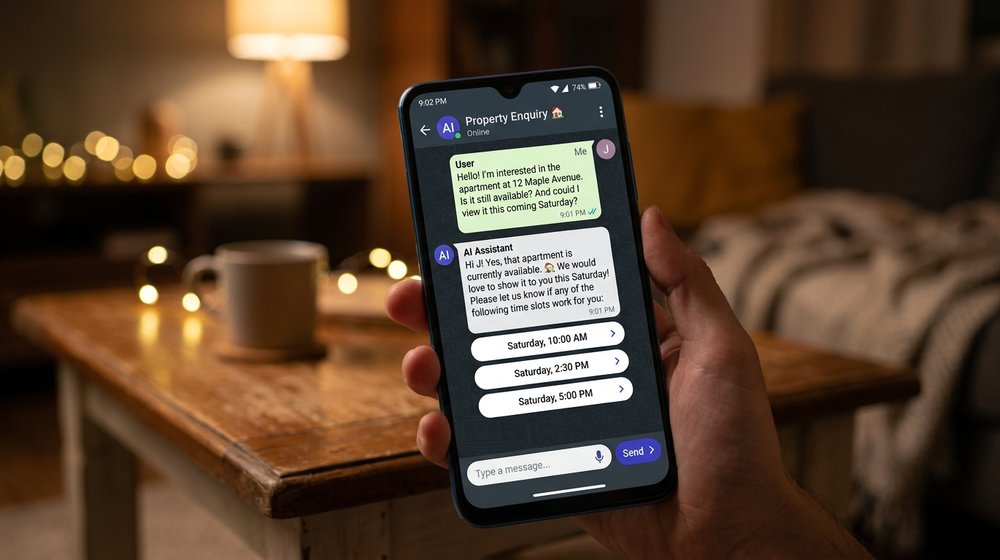
A well-built AI receptionist reads the enquiry, replies within seconds by email, SMS or WhatsApp, answers the obvious questions (“Is it still available?”, “Can I view Saturday?”, “Do you do free valuations?”), asks the two or three qualifying questions that matter (buying or selling, chain, budget, timescale, area), and books the viewing or valuation into the diary. Anything it isn't sure about, it hands to a human. That is the whole game: instant, every time, on the channel the customer already uses.
2. Viewing & valuation booking
Once a lead is qualified, the assistant offers your real availability and books straight into the branch calendar, then sends confirmation and reminder messages to cut no-shows. Reminders are dull and they work: a nudge the morning of a viewing recovers slots that would otherwise quietly evaporate. This is exactly what an AI appointment setter does in practice.
3. Buyer & vendor messaging
Chains live or die on communication. AI-assisted messaging over WhatsApp or SMS keeps both sides updated — “the survey's booked”, “we're chasing the solicitor” — without a negotiator typing the same status update forty times a week. The tone stays consistent and nothing gets forgotten; the negotiator steps in for the calls that need a human.
4. Listing content — useful, but handle with care
AI writes a decent first draft of property particulars, brochure copy and social posts in seconds. That's a genuine time-saver. But this is also where agents get themselves into trouble, so read the compliance section below before you let it anywhere near a live listing. AI drafts; a human approves. Always.
5. Getting found in AI search (the new one)
Vendors and buyers increasingly ask ChatGPT, Google's AI Overviews and Perplexity questions like “best estate agent in [town]” or “how do I choose an estate agent”. If those tools don't know your agency exists, you're invisible in a channel your competitors haven't noticed yet. Making sure AI assistants can find, understand and recommend you is called Generative Engine Optimisation — and it's a different discipline from ranking blue links. Start with a free AI visibility check or a full SEO audit, and read how to rank in ChatGPT in 2026. Google's own Search Central guidance on helpful, structured content applies here too.
AI search services for estate agents: what to ask for
A few agencies and software companies now sell “AI search” services to estate agents. Some are genuine; some are ordinary SEO with a new label. The test is whether the work changes what AI engines can actually find and say about your branch. A useful service should cover these, and you can check each one yourself:
- Crawler access. Your website's
robots.txtshouldn't block the crawlers AI tools use, such as GPTBot, PerplexityBot and Google-Extended. - Consistent facts. Branch name, address, opening hours, areas covered and fees should match across your website, your Google Business Profile and the portals. AI engines repeat whatever they find, including the out-of-date version.
- Answer-style pages. Short, plain answers to what vendors actually ask: how you value, what you charge, how long sales are taking in your area.
- Reviews. Recent Google reviews help local search and give AI tools something to go on, which is why review requests are in the automation order below.
- A before-and-after test. Ask ChatGPT, Gemini and Perplexity for the “best estate agent in [your town]” before any work starts, and again afterwards. If a service can't show you that comparison, you're paying for a report, not a result.
You can run the crawler and mention checks yourself with a GEO audit, or read what AI search visibility means first.
6. CRM & admin automation
The quiet time-sink. AI and workflow automation can move enquiry data into your CRM, tag leads, trigger follow-ups, and request a review after completion — the tasks you mean to do and never quite get to. It won't win headlines, but it hands your team back hours every week.
AI prospecting tools for estate agents
Prospecting is where AI gets oversold to agents. The useful part is narrow: spotting likely instructions sooner and making follow-up less of a chore.
- Watching the market for signals. Tools that flag listings withdrawn or reduced on the portals, or homes sitting unsold for months, give negotiators a shortlist of vendors who may be ready to switch agent.
- Drafting the first letter or email. AI can write a personalised valuation letter in seconds. A person should still read it before it goes out.
- Keeping follow-ups on schedule. The homeowner who said “maybe in spring” gets a call in spring, not never.
The compliance line matters more here than anywhere else in this guide. Unsolicited marketing emails and texts to individuals fall under PECR, and the personal data under UK GDPR, so read the ICO's direct marketing guidance before you point any tool at a list of homeowners. A tool that sends cold messages at volume can create legal risk faster than it creates instructions.
Building your estate agent AI toolkit
You don't need all of this at once. A sensible toolkit for a small branch has four pieces, and most agents already own two of them.
| Job | What it needs to do | Where most agents start |
|---|---|---|
| Lead response | Reply to portal and website enquiries within minutes, day or night | An AI receptionist or assistant connected to the enquiry inbox |
| Diary | Offer real viewing and valuation slots, then send reminders | The calendar the branch already uses |
| CRM | Keep every lead, stage and follow-up date in one place | Your existing property CRM |
| Visibility | Get the branch found on Google and named by AI assistants | A free AI visibility check, then the fixes it points to |
Start with lead response, connect it to the diary and CRM you already have, and add visibility work once enquiries are being handled properly.
DIY tool vs done-for-you AI receptionist
Two honest routes. Neither is wrong — it depends on your time and how specific your branch's rules are.
| DIY AI tool | Done-for-you AI receptionist | |
|---|---|---|
| Setup | You build and maintain the flows | Built and maintained around your branch |
| Knows your stock & areas | Only what you configure | Trained on your patch, fees and rules |
| Books viewings | Often not, or bolt-on | Yes — into your real diary |
| Escalation to a human | Basic | Rules-based, to the right negotiator |
| Compliance control | On you | Guardrails built in, human sign-off |
| Typical cost | ~£20–£100/mo | Setup fee + monthly (often low hundreds) |
| Best for | Simple needs, hands-on owner | Branches that want it handled |
Not sure what the maths looks like for your branch? Our free AI chatbot cost calculator lets you compare doing nothing vs a generic tool vs a custom assistant using your own numbers.
What to automate first (a sensible order)
- Instant portal & website response — the single biggest lever on conversion.
- Qualification & viewing booking — so only real leads reach a negotiator, already in the diary.
- Reminders & chain updates — fewer no-shows, calmer vendors.
- Post-completion review requests — more Google reviews, which feed both local SEO and AI recommendations.
- Listing-draft & admin help — last, because it saves time but rarely wins the instruction on its own.
The compliance bit estate agents cannot skip
Two rules matter, and AI doesn't get you out of either.
- Lead & client data (UK GDPR). Enquiry data is personal data. Whatever tool you use must handle it lawfully — clear privacy information, a proper basis for processing, sensible retention. The ICO is the authority to check against, and any reputable provider should be able to tell you where data is stored and how it's secured.
- Listings must not mislead (CPRs & material information). Under the Consumer Protection from Unfair Trading Regulations and the material-information rules for property listings, particulars must be accurate and include the required facts. AI-generated copy that invents a feature or omits material information is your liability, not the tool's. Bodies like Propertymark publish guidance worth following. The safe workflow is simple: AI drafts, a qualified human verifies against the facts, then it goes live.
The fastest payback in estate-agency AI isn't the tool that writes the prettiest particulars. It's the one that makes sure the 9pm enquiry you'd otherwise have missed gets answered — instantly, every time.
How Pivot Bureau approaches this
Pivot Bureau builds done-for-you AI assistants for UK small businesses — including service businesses like estate and letting agents. The principle is the same across every build: automate the fast, repeatable customer contact (response, qualification, booking, follow-up), keep a human in the loop for valuations, negotiation and anything compliance-sensitive, and make sure AI search engines can find and recommend you. If you're weighing it up, see how the AI receptionist works, browse the free tools, or read the wider picture in how to use AI for small businesses in the UK and AI agents for small business.