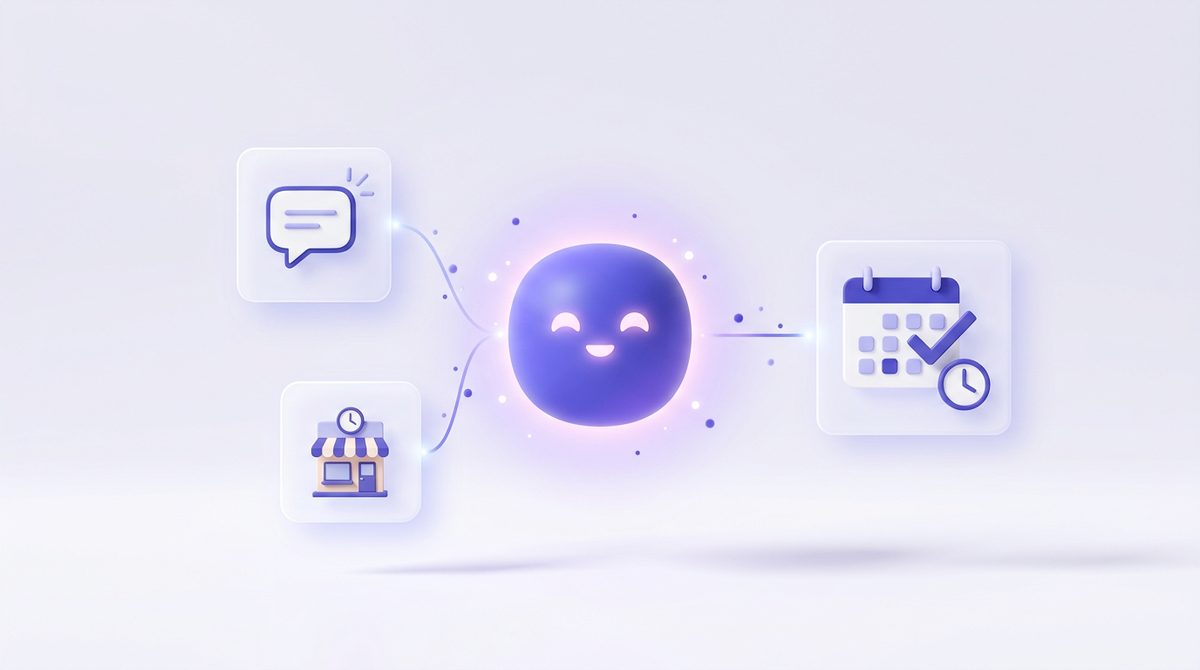
This guide covers what to automate first, realistic UK costs, and how to start without hiring a developer.
What "using AI" actually means for a small business
Ignore the noise about replacing your team. For a plumber, an estate or letting agent, a clinic or a salon, practical AI in 2026 falls into three buckets:
- Response & booking automation — an AI receptionist or assistant that replies to enquiries, answers FAQs, qualifies the lead, books the slot, and hands anything tricky to you. Highest ROI for most.
- Back-office automation — quotes, invoices, follow-ups, review requests, and moving data between your tools (CRM, calendar, spreadsheets) automatically.
- Content & admin assistance — drafting emails, listings and social posts. Useful, but rarely the thing that wins you a customer.
Start with the first bucket. It touches revenue directly.
What to automate first (in order)
1. Instant enquiry response
A customer messaging at 8pm doesn't want to wait until tomorrow. An AI assistant on WhatsApp or your website replies in seconds, answers common questions ("Do you cover my area?", "How much for a boiler service?"), and captures the details you need. The business that replies first usually wins the job.
2. Lead qualification
Not every enquiry is worth your time. AI can ask the three or four questions that tell you whether a lead is a real job, a price-shopper, or out of area — so you only pick up the phone for the ones that matter.
3. Booking & calendar
Once a lead is qualified, the assistant offers your real availability and books straight into your calendar — and can take a holding deposit so the slot sticks. (This is what an AI appointment setter does in practice.)
4. Follow-ups & reviews
After the job, an automated nudge asks for a Google or Trustpilot review, and a reminder chases unpaid invoices. These are the tasks you mean to do and rarely get round to.
How much does AI cost a UK small business?
Costs vary, but realistic 2026 ranges for a small UK business:
- DIY chatbot tools (Tidio, Chatbase, etc.): roughly £20–£100/month, but you build and maintain it yourself, and generic bots often can't book jobs or handle your specific pricing.
- Done-for-you AI assistant (built and managed for you): typically a setup fee plus a monthly fee — for context, Pivot Bureau's WhatsApp Self Check-In is £80 setup + £39/property/month, and AI receptionist builds start in the low hundreds. You get something tailored to your trade rather than a generic widget.
- Custom builds / agentic automation: priced per project depending on the integrations.
The honest test isn't the monthly fee — it's whether the system recovers more than one extra job a month. For most trades, one recovered enquiry covers the cost several times over. (For a full breakdown, see what an AI receptionist costs in the UK.)
Do you need a tech team? No.
You don't need to hire a developer or learn to code. The two practical routes are:
- Use a DIY tool if your needs are simple and you have time to set it up and keep it working.
- Use a done-for-you provider if you'd rather describe your business once and have the system built, connected to your calendar and CRM, and maintained for you.
Either way, the work that matters is defining the rules: what to answer automatically, what to escalate to you, your prices, and your availability.
A simple 30-day starter plan
- Week 1: Write down your 10 most common customer questions and your standard answers. List the jobs you price the same way every time.
- Week 2: Pick one channel (usually WhatsApp or website chat) and set up an assistant to answer those FAQs and capture enquiry details.
- Week 3: Connect booking — let it offer your real availability and book into your calendar.
- Week 4: Add a post-job review request and an unpaid-invoice reminder. Review what it's handled and tune the rules.
Common mistakes to avoid
- Automating pricing you shouldn't. Some jobs need your eyes first — let the assistant gather details and escalate, never guess.
- Buying a generic bot that can't book. A chatbot that only answers FAQs leaves money on the table; the value is in qualifying and booking.
- Setting and forgetting. Review the conversations monthly and refine the rules — that's where the gains compound.
- Starting with content, not customers. AI-written social posts feel productive but rarely win a job. Fix response speed first.
The fastest payback in small-business AI is almost never the clever stuff. It's answering the enquiry you would otherwise have missed — instantly, every time, on the channel the customer already uses.
How Pivot Bureau approaches this
Pivot Bureau builds done-for-you AI assistants for UK small businesses and short-term-rental hosts — AI receptionists, WhatsApp automation, and our flagship WhatsApp Self Check-In for Airbnb hosts. The principle across all of them: automate the fast, repeatable customer contact, and always keep human judgement in the loop for the decisions that need it. See how the AI receptionist works, or learn the wider shift in AI agents for small business. And if you want customers to find you through ChatGPT and Google's AI answers too, here's how to rank in ChatGPT in 2026.