The quietest way to lose a job
A customer needs a plumber. They don't message one — they message three, off Checkatrade or a quick Google, and they get on with their day. Whoever replies first, with a sensible answer and a price, usually wins. The other two never hear back, and never find out why.
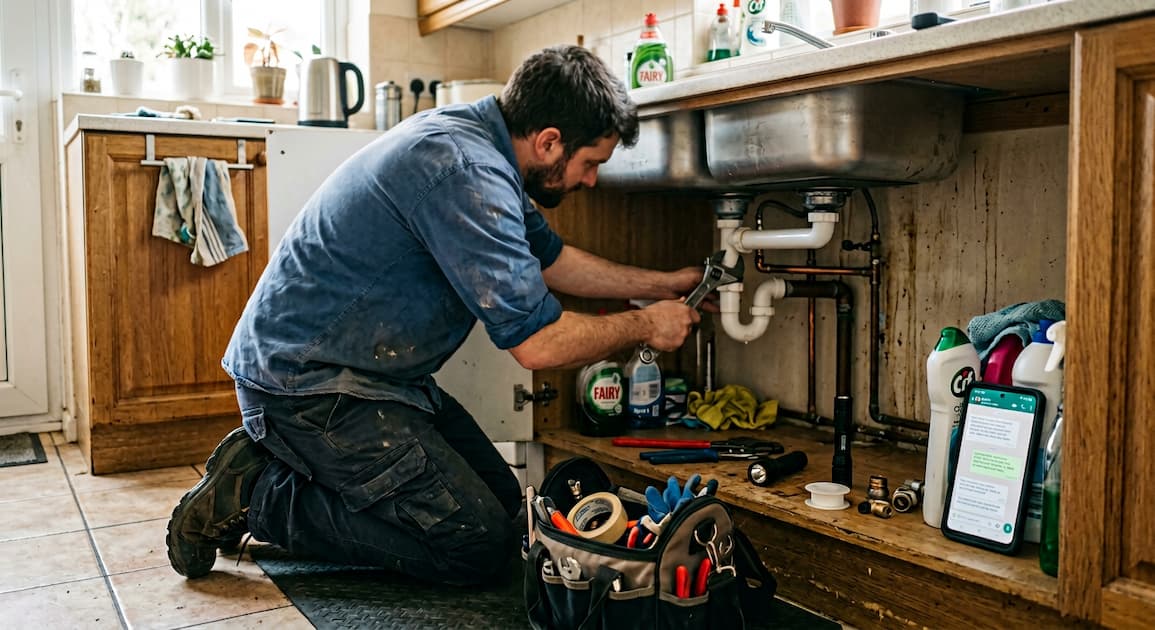
If you're a sole trader, you are almost always one of the two who lost. Not because you're worse — because you were on your knees under someone else's sink when the message came in, and by the time you'd finished, washed your hands and found your phone, the customer had already booked the bloke who answered in ninety seconds.
Across the trades and home-services world, surveys keep landing on the same uncomfortable number: around one in four enquiries is lost purely to a slow reply. Not bad leads. Not tyre-kickers. Real jobs, gone because nobody picked up fast enough.
Why "just reply faster" doesn't work
Every tradesperson already knows speed matters. The advice "just reply quicker" is useless, because the entire problem is that you physically cannot. The options on offer are all bad:
- Down tools every time the phone buzzes — you'll never finish a job, and you'll still miss the messages that land while your hands are wet.
- Quote in the evening — by then half of them have booked someone else, and you're giving up your night to do admin after a ten-hour day.
- Pay for an answering service — they can take a message, but they can't look at a photo of a leaking valve and tell the customer it's "usually £90–£160."
What you actually need is something that can hold a normal conversation, ask for a photo, and give a sensible ballpark on your prices — instantly, every time, without you lifting a finger. That's what an automated WhatsApp quoting assistant does.
How automated WhatsApp quoting works
It sits on top of a WhatsApp business number and handles the front of every enquiry for you. A typical job runs like this:
- Customer messages. "Hi, are you available? My kitchen sink is blocked." The assistant replies in seconds and asks what they need doing.
- It gets the details and a photo. Before giving any price, it asks for a photo or a short video — the same thing you'd ask for yourself.
- It estimates on your rules. Using your call-out fee, day rate and standard job prices, it gives an honest range — "usually around £90–£160" — and makes clear you'll confirm the final figure.
- It offers your slots and books them in. It shows your real availability and can take a small holding deposit so the customer actually turns up.
- You approve the price. The job, the photos and the suggested price land on your phone. One tap sends it. Anything big or unusual comes to you first, before any number goes out.
You can watch a 30-second demo of exactly this — the customer's chat on one side, and what lands on your phone to approve on the other.
Split your work into two piles: what to auto-quote, what to send straight to you
The trick to automating quoting isn't quoting everything — it's quoting the jobs you price the same way every time, and routing the rest, with the photos already gathered, to you. Every trade's job book splits cleanly in two, and a well-built assistant respects that line.
Pile one — jobs you price the same way every time: standard, repeatable work the assistant can estimate the moment the enquiry lands, straight from your rates. Pile two — jobs that always need your eyes first: anything complex, high-value or safety-critical — the assistant gathers the details and photos, then hands it to you to survey and quote. It never guesses at pile two, and it never gets to make exceptions. What lands in each pile depends on your trade:
Electricians
Half your jobs you can price in your sleep; the other half you'd never quote without a proper look — and your enquiries are often higher-value and time-sensitive (an EICR with a landlord's deadline, an EV charger before the new car arrives).
- Auto-quote: extra socket or spur, light fitting or switch swap, a fixed-price EICR for a standard 1–3 bed, a fault-finding call-out (price after diagnosis), smoke/heat alarms to a known spec.
- Always escalate to you: full or partial rewires, consumer-unit / fuse-board upgrades, EV-charger installs (load assessment, DNO, cable run), anything safety-critical (burning smell, exposed conductors, "the whole house has gone off"), and commercial or three-phase work.
Gas & heating engineers
Gas work carries a safety bar that some jobs simply must clear in person, so here the line matters more than in any other trade. Replying faster can never mean replying looser.
- Auto-quote: annual boiler service (fixed by boiler type or age), a landlord gas safety certificate / CP12 (with portfolio rates for multi-property landlords), a cooker or hob safety check alongside a CP12, a known repair on an already-diagnosed part.
- Never auto-price — always you, in person, first: new boiler installations (system sizing, flue route), a full heating diagnosis or power-flush assessment, any smell of gas or suspected carbon monoxide, and no-heating-in-winter for an elderly or vulnerable customer. If a message even hints at a safety issue, the assistant's only job is to flag it to you fast — never to price it.
Plumbers, joiners, roofers and the rest follow the same shape: a list of everyday jobs the assistant quotes on your rates, and an "always ask me first" list it hands straight to you.
"But I don't want a robot making up my prices"
This is the first thing every good tradesperson says, and they're right to. Pricing is personal — it's your reputation and your margin in one number. So the assistant doesn't touch it the way you're imagining.
It never invents a price. It only ever quotes from the rules you set: your call-out fee, your hourly or day rate, your standard prices for the jobs you do all the time, and — crucially — the list of jobs that always need your eyes before any number is mentioned. A boiler swap, anything that smells like gas, a "no water in the whole house" panic, a job it doesn't recognise — those don't get auto-priced. They get flagged straight to you.
And by default, even the everyday quotes don't go out until you say so. The draft sits on your phone; you glance at it between jobs, tap to send, or change the number first. You stay exactly as in control as you are today — you just stop being the bottleneck on the first reply.
It's a quoting assistant that works the way you already do — ask for a photo, price it on your rates, send it once you're happy — not a black box guessing numbers on your behalf.
What it doesn't change
Your number stays yours. The assistant runs on a separate business line, so your jobs stay organised and your personal mobile isn't exposed. You can switch it off any time you fancy taking a chat yourself. Customers from Checkatrade, a van sign, a recommendation or a Facebook group all land in the same place and get the same fast, polite first reply.
It also keeps working after the job's done: it can send the customer a nudge for a Google or Checkatrade review a few hours later — the reviews that win you the next ten jobs, and the ones you always mean to ask for and never do.
Is it worth it?
Run the maths on your own numbers. If you're spending money on leads — Checkatrade, Bark, Google — you're already paying for the enquiries you then miss. Recovering even one extra job a month from faster replies typically covers the cost several times over, before you count the evenings you get back.
It's built for plumbers first, with electricians and gas/heating engineers next — but if your customers message to describe a job and you quote it, the same approach fits. You can see how it works, including the price, on the WhatsApp Auto-Quote page, or just tell us about your trade and we'll build the pricing rules with you.
The one thing to do this week
Open your WhatsApp and your call log and count, honestly, how many enquiries in the last month you replied to more than an hour late — or never. That number, times your average job, is roughly what slow replies are costing you. If it's more than a rounding error, automated quoting is worth a proper look.