Part of our complete guide to AI search visibility.
The shortest possible definition
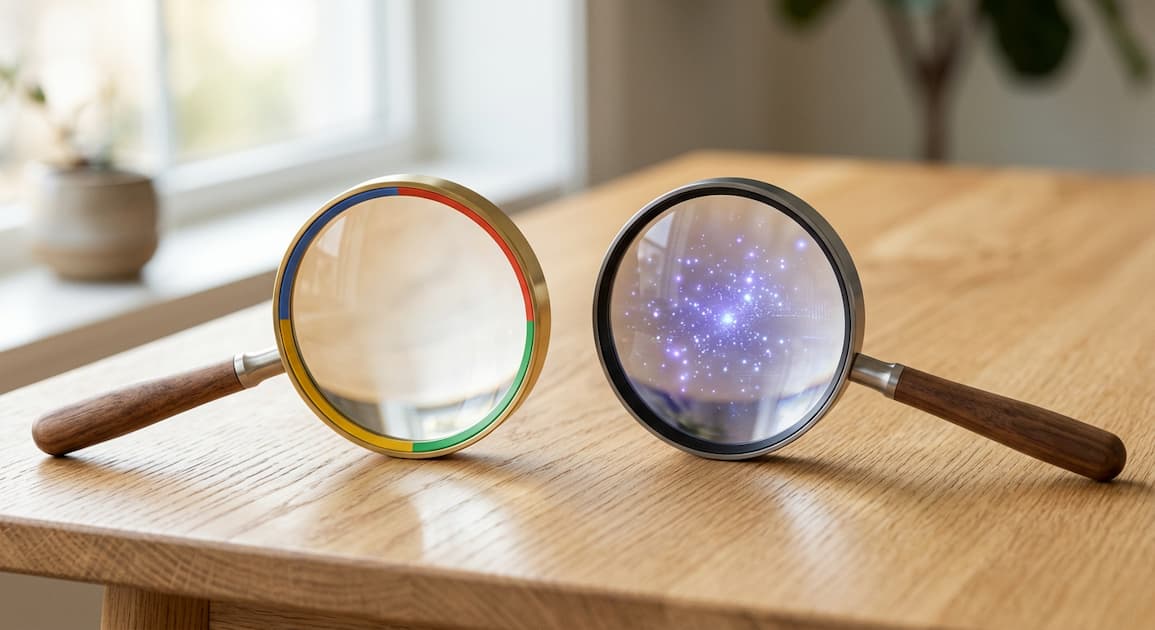
SEO optimises for a position on a results page. GEO optimises for a mention inside an answer.
When a customer Googles "best plumber in Manchester" they see ten ranked links and pick one. SEO is the work that gets your business into those ten. When the same customer asks ChatGPT, Gemini or Perplexity the same question, they see a single written answer that mentions three or four plumbers by name. GEO is the work that gets you mentioned in that answer.
The same business can be excellent at SEO and invisible to GEO. That is the normal state of things in 2026.
The acronym landscape
There are three labels in circulation. They're related but not identical:
- SEO — Search Engine Optimization. The full traditional discipline: technical, on-page, content, off-page, local. Output: ranking on Google and Bing.
- GEO — Generative Engine Optimization. The full discipline aimed at AI engines (ChatGPT, Gemini, Perplexity, Copilot). Output: mentions inside AI-generated answers.
- AEO — Answer Engine Optimization. The content-formatting subset of GEO: writing pages as direct questions with direct answers so AI engines can extract them cleanly. AEO is a part of GEO, not a parallel discipline.
Some teams also use "AI SEO" or "AI search optimization" as synonyms for GEO. They mean the same thing.
Side-by-side: SEO vs GEO
| Dimension | Traditional SEO | GEO |
|---|---|---|
| Surface | Google / Bing results page | ChatGPT, Gemini, Perplexity, Copilot, Google AI Overviews |
| Output unit | Ranked link with snippet | Mention inside a written answer |
| Measured by | Rank position, CTR, organic traffic | Mention rate across queries, AI Visibility Score 0-100 |
| Core index | Google's crawl | Bing's index (for ChatGPT/Copilot) + Google + Perplexity's own crawl + LLM training data |
| Schema weight | Helpful | Critical — AI engines lean on structured data to extract facts |
| Reddit weight | Low | High — Reddit is a primary training source for Gemini and a citation source for ChatGPT |
| Directory citation weight | Local SEO only | Significant — Clutch, Crunchbase, Sortlist, GoodFirms are entity-confidence signals |
| Content format | Comprehensive, long-form | Question-format H2s with direct 40-80 word answers |
| Time to first lift | 3-6 months | 6-12 weeks for most levers; Bing schema lifts can appear in days |
Where SEO and GEO overlap
These are the levers that move both at once. Prioritise them first if you have to choose:
- Schema.org structured data. Organization, LocalBusiness, Service, FAQPage and Article schema all help Google understand your pages and help AI engines extract facts about your business. The same JSON-LD block earns you in both surfaces.
- Page speed and Core Web Vitals. Google ranks faster pages higher; AI engine crawlers timeout slower pages and skip indexing them. Either way, slow pages cost you.
- Strong on-page content. Substantive, factually accurate, well-structured content rewards traditional ranking signals and gives AI engines something extractable to cite.
- Canonical URLs and a clean sitemap. Both Google and AI crawlers waste budget on duplicate or redirect-chained URLs. Clean technical hygiene helps both.
- HTTPS, security, accessibility. Table stakes for ranking, table stakes for being trusted as a source.
Where GEO diverges from SEO
These are the GEO-specific levers. They barely move Google rankings, but they move AI visibility decisively:
1. Bing Webmaster Tools verification
ChatGPT and Copilot are powered by Bing's index, not Google's. If you have never verified your site at bing.com/webmasters and submitted your sitemap, you are invisible to ChatGPT — even if Google ranks you #1. This is a 15-minute task that has outsized GEO impact.
2. Reddit and forum mentions
Gemini training data weights Reddit heavily. Perplexity surfaces Reddit threads directly. A single high-quality Reddit thread that mentions your business in a relevant subreddit (r/SEO, r/smallbusiness, r/marketing for an agency; r/cooking, r/EatCheapAndHealthy for a restaurant) can outweigh ten backlinks for AI visibility. Traditional SEO largely ignores Reddit signal.
3. Directory citations beyond local SEO
Google cares about directory citations mostly for local SEO (NAP consistency for local pack ranking). AI engines use directory listings as entity-confidence signals — proof that your business is real, claimed, and worth mentioning. Clutch, Crunchbase, Sortlist, GoodFirms, LinkedIn Company Page, and 2-3 niche industry directories should be live and consistent.
4. AEO content formatting
SEO content is rewarded for being comprehensive. GEO content is rewarded for being extractable. The fix is mechanical: turn H2s into questions a customer would actually type, follow each with a direct 40-80 word answer, and wrap the lot in FAQPage schema. This is exactly the format you're reading now.
5. Entity consistency
Your business name, address, phone, founding date, and service list should match exactly across every surface — your site's Organization schema, Google Business Profile, Bing Places, LinkedIn, Clutch, Crunchbase. Inconsistency tells AI engines they aren't sure which "your business" is the real one, so they hedge by mentioning neither.
How to know which discipline you need
Most small businesses need both — but the priority order depends on where you are today:
- You have steady Google traffic but feel the click volume slowly dropping? AI Overviews and ChatGPT are absorbing your informational queries. GEO first, SEO maintenance second.
- You're newly launched with thin Google presence? Run both in parallel. GEO has faster signal pickup because Bing's index is less crowded; SEO compounds over time.
- You sell something transactional and locally specific (plumber, restaurant, dentist)? Local SEO still drives most of your phone calls, but GEO is rising fast for "best X in [city]" queries. Both, in that order.
- You're a B2B service provider? GEO is now critical. B2B researchers ask ChatGPT, Gemini and Perplexity for shortlists before they ever Google a vendor.
The 1-week GEO starter checklist
If you read this far and want to act, this is the smallest meaningful push you can make in seven days:
- Day 1. Verify your site on Bing Webmaster Tools and submit your sitemap.
- Day 2. Add Organization + LocalBusiness schema with full NAP and a
sameAsarray linking to your LinkedIn, Crunchbase and any directory profiles. - Day 3. Claim profiles on Clutch, GoodFirms, Sortlist and Crunchbase. Match every NAP detail to your site exactly.
- Day 4-5. Rewrite your two most important pages with question-format H2s and FAQPage schema. Start with your homepage and your top service page.
- Day 6. Identify three Reddit threads in your space where you can contribute value. Reply with genuine help; mention your business only where contextually appropriate.
- Day 7. Run a free AI SEO audit on your site to measure baseline AI Visibility Score, then re-run at week 6 to see the delta.
Related reading
If you want to go deeper before you start work:
- What is AI search visibility? A complete guide for small businesses
- Why is my business invisible to ChatGPT? 7 reasons and how to fix each
- Schema.org for AI search: the 4 schemas that move rankings
- How to rank in ChatGPT in 2026: a practical guide
- Beyond the chatbot: how agentic AI grows a small business in 2026
- WordPress Application Passwords for AI agents: the safe way to give access
If you only do one thing
Measure your baseline. Run a free PivotScan™ Comprehensive Audit on your own site — it takes 90 seconds to submit, returns an AI Visibility Score 0-100 within three minutes, and tells you exactly which of the GEO levers above will move yours the most. No card, no sales call, one report.
When you're ready for the work done for you, the Fix Delivery tiers start at £299 one-off with a 6-week rank guarantee — if your AI visibility hasn't moved at the Day-40 re-audit, we work another month free.